
Kerberos Authentication for Aurora PostgreSQL: Mapping AD Groups to Database Roles
Learn how you can enable map your security roles in Aurora PostgreSQL to AD groups using Kerberos.
2026-08-26
1,266 reads
Learn how you can enable map your security roles in Aurora PostgreSQL to AD groups using Kerberos.
2026-08-26
1,266 reads
Overview In this article, we will understand how we can connect to PostgreSQL using Node.js application. We will start with setting up PostgreSQL in our local system and perform basic CRUD operations to interact with the PostgreSQL database. Prerequisites To start with this, we need the following conditions to be met: Windows machine (or any […]
2025-07-24
1,387 reads
2024-12-06
1,578 reads
Learn how to get started with PostgreSQL using a container to practice database skills.
2024-11-08
2,132 reads

PostgreSQL has a separate command-line tool that’s been available for decades and is included with any installation of PostgreSQL. Many long-term PostgreSQL users, developers, and administrators rely on psql to help them quickly connect to databases, examine the schema, and execute SQL queries.
Knowing how to install and use basic psql commands is an essential skill to have for anyone that will connect to PostgreSQL.
2023-09-20

It can be a daunting task for new users to get to grips with PostgreSQL documentation, particularly if you are not from a developer background.
If you are not sure where to start, we are here to help break down the different resources available so you can make the most of them.
In the latest webinar of our PostgreSQL 101 series, join Ryan Booz, PostgreSQL Advocate at Redgate, and Grant Fritchey, Microsoft Data Platform MVP, and discover:
- How to navigate PostgreSQL documentation
- The essential things you need to know about PostgreSQL documentation
- Other useful learning resources to help make your journey to using PostgreSQL easier
Register to join us on September 19th at 11am CT (5pm BST)
2023-09-18
An important aspect of building and managing a database is organizing the objects within your database. You may have tables that support different functions, for example, a schema for warehousing operations and another for sales. Some logins may need access to some tables, but not others. You might want to isolate one set of objects within a database from other sets of objects. All of this, and more, can be accomplished using schemas within a database and PostgreSQL supports the use of schema for just these types of functions.
2023-08-16
Extensions are a unique and powerful capability in PostgreSQL, a feature that other relational databases do not provide. Taking advantage of the extension framework in PostgreSQL is a true advantage to using the platform.
In this webinar, find out how PostgreSQL extensions can help you find solutions to some of your common problems.
Register now and to join on August 22nd
2023-08-11
This article describes six performance metrics that ought to be central to your PostgreSQL monitoring strategy. By using a tool like SQL Monitor to track these metrics over time, and establish baselines for them, you'll be able to spot resource pressure or performance issues immediately, quickly diagnose the cause, and prevent them becoming problems that affect users.
2023-07-17
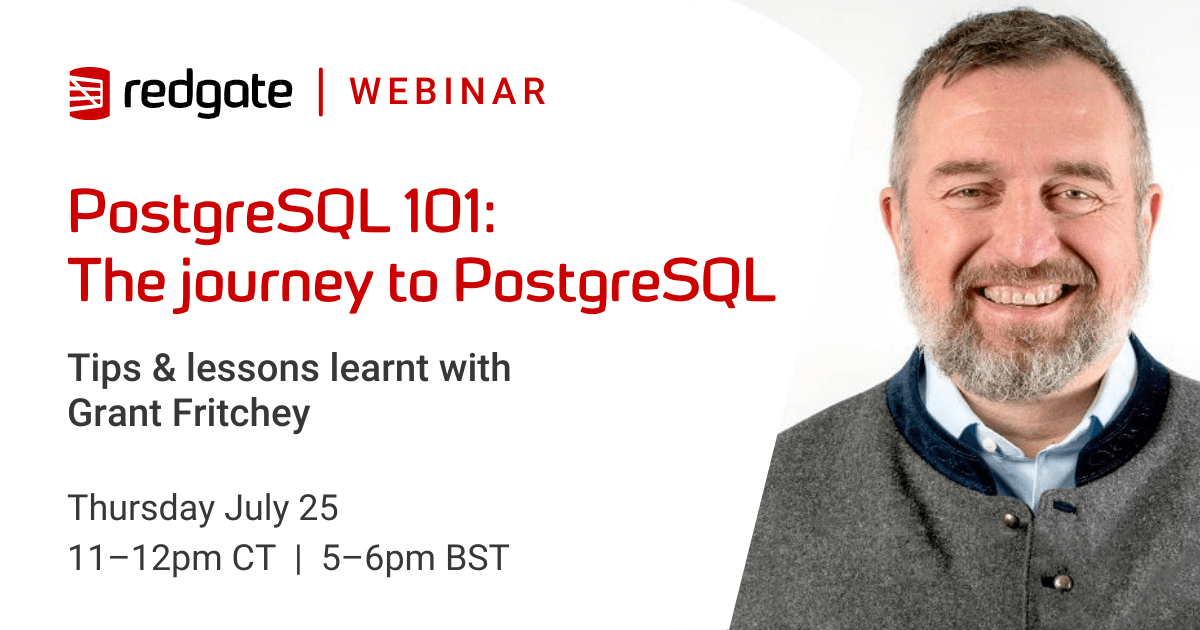
Want to hear someone else’s experience of learning PostgreSQL from scratch? Then look no further.
Grant Fritchey, Microsoft Data Platform MVP, started working with SQL Server in 1995 but more recently has needed to support and understand PostgreSQL. In this webinar, he will go on a deeper dive into the PostgreSQL database and will share top tips from his own learning journey.
Join us on July 25th
2023-07-14
By SQLPals
How to Clear the SSMS Cache (SSMS 21 and Later) Updated...
By Arun Sirpal
“What exactly did it do on my server?” is the first question a DBA...
By James Serra
Microsoft shared a broad set of Fabric, Power BI, and SQL updates at FabCon...
Comments posted to this topic are about the item Let's Talk Certifications
Comments posted to this topic are about the item The Hidden Security Risks of...
Comments posted to this topic are about the item The Empty Aggregate
I have this table in a SQL Server 2025 database:
CREATE TABLE [dbo].[CustomerOrder]
(
[OrderID] [int] NULL,
[CustomerID] [int] NULL,
[total] [money] NULL
) ON [PRIMARY]
GO
What is returned from this code? (answers are for the sum and then the count)
SELECT SUM(total) AS sum,
       COUNT(total) AS count
FROM dbo.CustomerOrder;
See possible answers