
2007-03-07 (first published: 2003-06-30)
433 reads
2007-03-07 (first published: 2003-06-30)
433 reads
There are many times you have to deploy a common code in all of your SQL Servers. I am sure there might be thousands of way to do this, but here is how I do it and it works great. Good thing is - you can either pass SQL Statement or a SQL script (in […]
2007-03-05 (first published: 2005-05-26)
831 reads
To provide data analysis you may need to perform some basic trend analysis. For example, if you want to identify the percentage of change in the number of orders received from one month to the next. The challenge to providing that on the fly is the change can be either an increase or a decrease, […]
2007-03-02 (first published: 2007-01-25)
6,549 reads
I find myself refacoring an existing database which has some inefficient code, like cursors in stored procedures and triggers ...Wanting to figure out which objects contained this "poor" code, I made myself a little script to list all the objects which contain a search string.Just change the value that @search is set to and run […]
2007-03-01 (first published: 2007-02-07)
1,202 reads
sometime I need to kill an program which does not continue to process data, and i sheduled a job to do that. After lots of times' try, I made it at last.This script add a shedule to the sheduled task list, one minutes later then the current system time. You can change it by edit […]
2007-02-28 (first published: 2004-09-19)
281 reads
Get the last date of the month for the given date. Algorithm is:1. Transform given date in “first day of the month” 2. Add a month to result 3. Subtract a day from second result
2007-02-27 (first published: 2004-09-30)
234 reads
This procedure is intended for single column primary key relationships.First we will create two table functions. The first finds a list of all tables with their primary key columns. The second finds all existing foreign key relationships with their table and column names. Finally we find all tables with primary key column names that do […]
2007-02-26 (first published: 2006-11-17)
982 reads
I wrote this to calculate the median on a record set. All you need to pass is the table name and column name. If you would like to filter the record set, create a view that displays the correct record.The limitation of not being able to pass arrays to Stored procedure or functions was the […]
2007-02-23 (first published: 2006-10-30)
667 reads
This script changes the physical, logical and file names of a database. It stores the current database until the next time the script is run, and creates a dummy database for the next update. The intent was to have minimal downtime even though the load (import, snapshot, etc.) may take a long time. Three copies […]
2007-02-22 (first published: 2006-10-17)
675 reads
The below command will rebuild all indexes on a database.We need to run the below command in the context of each database that is of interest.
2007-02-21 (first published: 2006-10-23)
1,243 reads
By Steve Jones
I recently started playing with the MCP Server for SQL Server, which is a...
If you spend your days tuning queries, managing pipelines, or keeping a production database...
I’ve been rebuilding my three-site SQL Server demo lab, and I ran into something...
Hub Via Wa 628218154374 Alamat Jl. A. R. Hakim No.2, Mangkukusuman, Kec. Tegal Tim.,...
Hub Via Wa 628217555651 Alamat Jl. Jend. Sudirman Jl. Diponegoro No.15, Salatiga, Kec. Sidorejo,...
Hub Via Wa:62817825533 Alamat Jl. Diponegoro No.27, Dukuh, Kec. Pekalongan Utara, Kota Pekalongan, Jawa...
I have added a few indexes to one of my tables in SQL Server 2025:
ALTER TABLE dbo.CustomerContact
ADD CONSTRAINT PK_CustomerContact
    PRIMARY KEY (CustomerID);

-- Create index on CustomerEmail
CREATE INDEX IX_CustomerContact_CustomerEmail
ON dbo.CustomerContact (CustomerEmail);
CREATE INDEX IX_CustomerContact_CustomerPhone
ON dbo.CustomerContact (phone);
I then do this to disable one index:
alter index IX_CustomerContact_CustomerPhone on dbo.CustomerContact disableI see this when I check the index status:
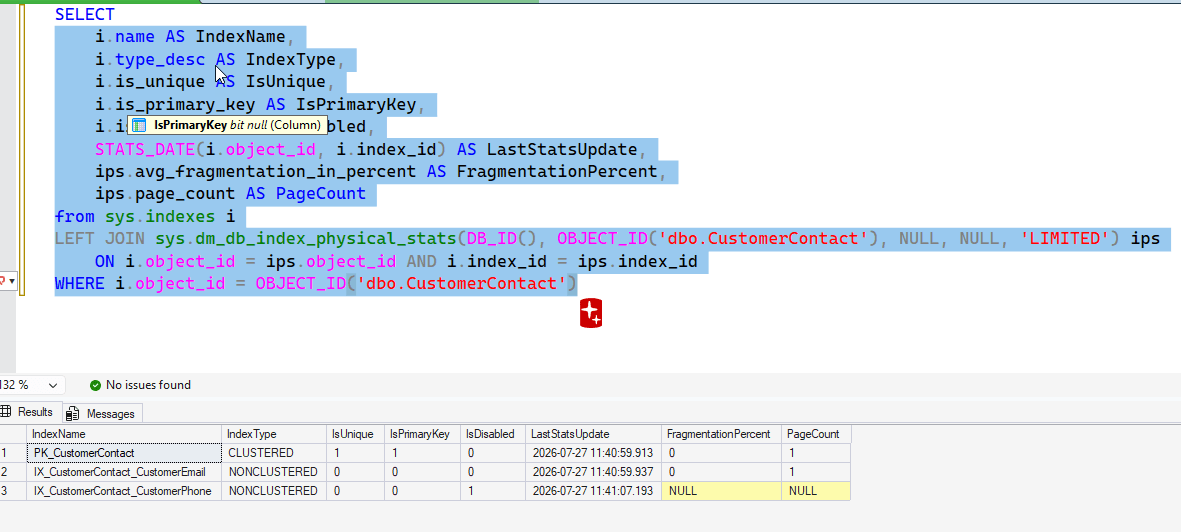 I decide to rebuild all indexes with this command:
ALTER INDEX ALL ON dbo.CustomerContact rebuildAfter I do this, what will I see for the index status? See possible answers