
2011-10-31 (first published: 2011-10-19)
2,277 reads
2011-10-31 (first published: 2011-10-19)
2,277 reads
A simple way to rename a file from within a T-SQL Script, primarily designed to add a date-time stamp. Works in 2000 and 2005.
2011-10-28 (first published: 2008-05-13)
2,986 reads
Find and Replace a string in all string fields (char, varchar, etc) of all tables in the database.
2011-10-27 (first published: 2008-02-08)
3,460 reads
Index maintenance procedure using rebuild or reorganized based on fragementation level.
2011-10-26 (first published: 2008-03-28)
3,492 reads
Many times we need to generate html query for a given SQL query for that we need to use ASP, Java. Now you can use this SP to generate HTML.
2011-10-25 (first published: 2007-10-01)
4,550 reads
This script reverse engineers SQL statements to recreate database permissions.
2011-10-24 (first published: 2011-10-07)
16,277 reads
Search for String Occurence with this script in your stored procedures.
2011-10-20 (first published: 2008-06-08)
5,407 reads
I have several problems with my corporate network and therefore need to do all my backups locally, and to make matters worse, still use SQL Server 2005.
2011-10-17 (first published: 2011-09-30)
439 reads
2011-10-14 (first published: 2011-08-24)
529 reads
Gets Detail table information such as partition information, compression, and partition range.
2011-10-13 (first published: 2011-09-30)
1,240 reads
By Steve Jones
I recently started playing with the MCP Server for SQL Server, which is a...
If you spend your days tuning queries, managing pipelines, or keeping a production database...
I’ve been rebuilding my three-site SQL Server demo lab, and I ran into something...
Has anyone written a wrapper function (or similar) around STRING_AGG() to allow the retrieval...
Putting this here as we're currently on SQL Server 2019 installed on Windows Server...
Comments posted to this topic are about the item Never is Not the Policy
I have added a few indexes to one of my tables in SQL Server 2025:
ALTER TABLE dbo.CustomerContact
ADD CONSTRAINT PK_CustomerContact
    PRIMARY KEY (CustomerID);

-- Create index on CustomerEmail
CREATE INDEX IX_CustomerContact_CustomerEmail
ON dbo.CustomerContact (CustomerEmail);
CREATE INDEX IX_CustomerContact_CustomerPhone
ON dbo.CustomerContact (phone);
I then do this to disable one index:
alter index IX_CustomerContact_CustomerPhone on dbo.CustomerContact disableI see this when I check the index status:
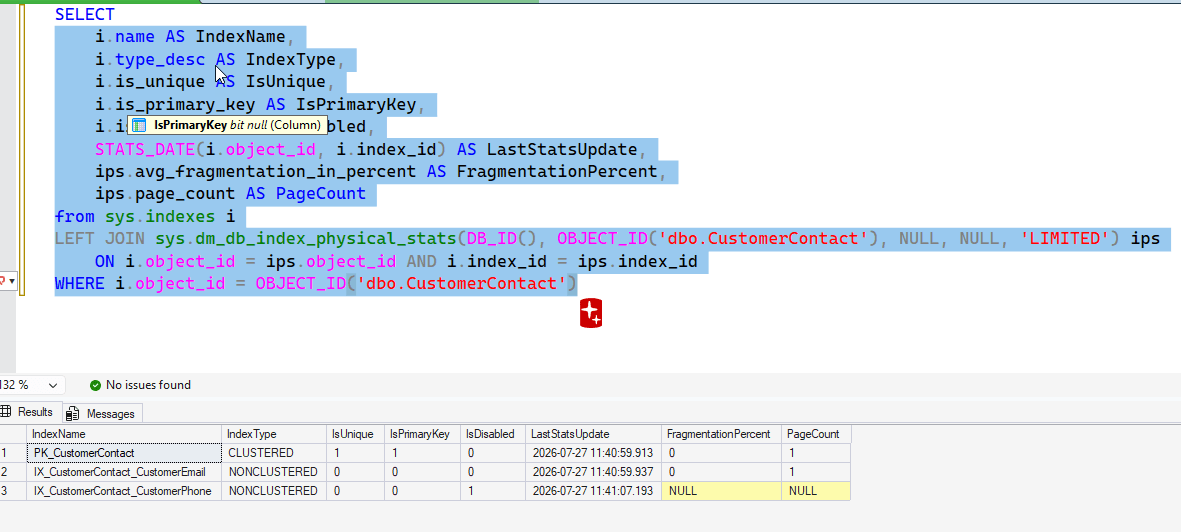 I decide to rebuild all indexes with this command:
ALTER INDEX ALL ON dbo.CustomerContact rebuildAfter I do this, what will I see for the index status? See possible answers