
2011-12-01 (first published: 2011-11-09)
1,288 reads
2011-12-01 (first published: 2011-11-09)
1,288 reads
This command is the equivalent of the LEFT() function (cumbersome but effective)
2011-11-29 (first published: 2011-11-14)
1,182 reads
ntext, text, and image (Transact-SQL). This script will alter the data type from image to
varbinary(max) which is very much required as the data type is out
of support.
2011-11-28 (first published: 2011-11-14)
878 reads
A SELECT statement which includes the alpha description of each job's schedule
2011-11-25 (first published: 2007-11-01)
4,573 reads
This creates a Tally or Numbers table which is frequently used to replace loops in code and is much faster than most loops.
2011-11-24 (first published: 2008-03-07)
6,707 reads
This script generates a audit trigger for each table in the database. The trigger then logs when each table is updated.
2011-11-23 (first published: 2008-05-09)
4,799 reads
2011-11-22 (first published: 2008-03-19)
5,893 reads
This is a simple method to load a SQL database with active directory account information without running into the 1000 record limit. You will need to change the SERVERNAME, PORT, DATABASENAME, USERID, AND PASSWORD values in the connection strings to your own values. You will also need to change the LDAP connection string values ('LDAP://SERVERNAME/ou=OUName,dc=host,dc=domain,dc=tld') […]
2011-11-21 (first published: 2007-08-01)
2,831 reads
2011-11-18 (first published: 2008-01-29)
2,913 reads
Calculates server uptime in days, hours, and minutes. Also calculates the UTC date (smalldatetime) when the server was started.
2011-11-17 (first published: 2007-08-31)
2,451 reads
By Steve Jones
I recently started playing with the MCP Server for SQL Server, which is a...
If you spend your days tuning queries, managing pipelines, or keeping a production database...
I’ve been rebuilding my three-site SQL Server demo lab, and I ran into something...
Has anyone written a wrapper function (or similar) around STRING_AGG() to allow the retrieval...
Putting this here as we're currently on SQL Server 2019 installed on Windows Server...
Comments posted to this topic are about the item Never is Not the Policy
I have added a few indexes to one of my tables in SQL Server 2025:
ALTER TABLE dbo.CustomerContact
ADD CONSTRAINT PK_CustomerContact
    PRIMARY KEY (CustomerID);

-- Create index on CustomerEmail
CREATE INDEX IX_CustomerContact_CustomerEmail
ON dbo.CustomerContact (CustomerEmail);
CREATE INDEX IX_CustomerContact_CustomerPhone
ON dbo.CustomerContact (phone);
I then do this to disable one index:
alter index IX_CustomerContact_CustomerPhone on dbo.CustomerContact disableI see this when I check the index status:
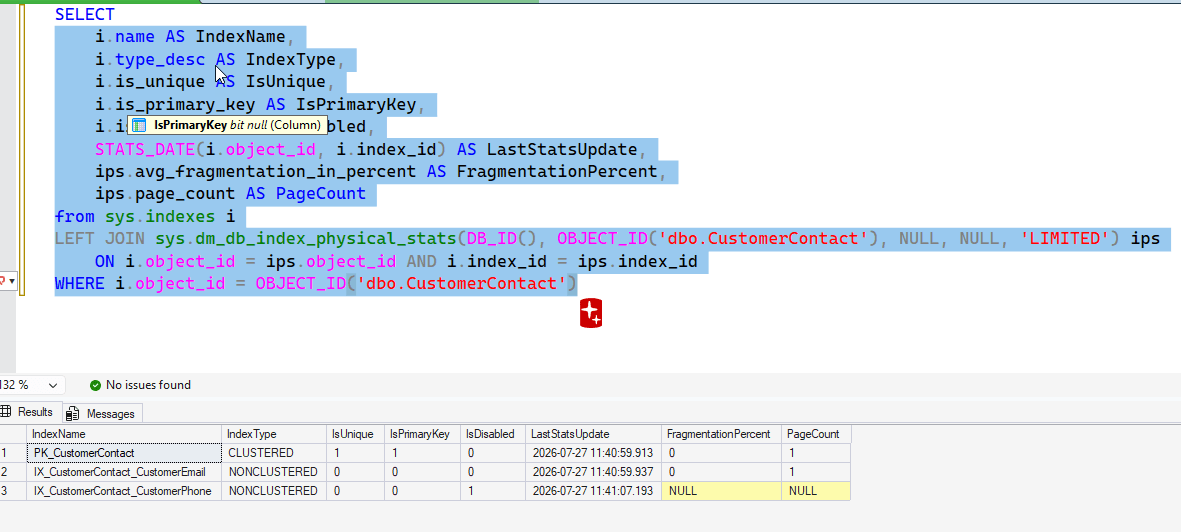 I decide to rebuild all indexes with this command:
ALTER INDEX ALL ON dbo.CustomerContact rebuildAfter I do this, what will I see for the index status? See possible answers