
Get all user tables with size
Returns User Tables by SIZE in DESCENDING ORDERAdd TOP n clause in SELECT to get selective results (i.e. TOP 10 TABLES)
2006-01-25 (first published: 2003-06-07)
2,466 reads
Returns User Tables by SIZE in DESCENDING ORDERAdd TOP n clause in SELECT to get selective results (i.e. TOP 10 TABLES)
2006-01-25 (first published: 2003-06-07)
2,466 reads
Script Table Data to Insert Statements - Handles Unicode datatypes (nchar, nvarchar, ntext). This script works with SQL 2000 and has been improved to handle properly the nchar, nvarchar, and ntext data types for Unicode, as well as handle apostrophes in data correctly. Usage is to run the script to create the stored proc in […]
2006-01-24 (first published: 2006-01-11)
609 reads
Post data as coming from an HTML FORM with METHOD=POST to an url and retrieve the result. The procedure uses WinHttp.WinHttpRequest.5.1
2006-01-24 (first published: 2005-01-27)
1,756 reads
This is BASE64 Encoding/Decoding in a T-SQL procedure. This code is provided as is, and is free to use and modify. Version 2 June 2005
2006-01-23 (first published: 2004-11-17)
4,899 reads
This VBA script was written for MS Word. It formats the text and sets default colors for keywords. SQL 2005's Management Studio now does this by default but the previous Query Analyzer did not offer this functionality. This is useful if you prefer to print and review code from time to time (not recommended for […]
2006-01-23 (first published: 2006-01-11)
498 reads
If you backup your databases to a disk file, you should make sure that these disk files are then being archived to tape. Without this, your ability to recover the database is compromised in the event of a disaster. This script will examine the "archive" flag on all of the backup files to make sure […]
2006-01-22 (first published: 2005-03-25)
315 reads
The following script deletes files in the specified folder, older than specified no of days and outputs the details to the specified file location. I use this VB script to delete some old backup files those can't be deleted with the regular maintenance plans. All you need to do is to supply the backup folder […]
2006-01-20 (first published: 2006-01-11)
1,776 reads
Calculates the next business day based upon the work weeklength, number of days from the start date and a list of holiday dates kept in a table called HolidayDate.Created this script for determining the next banking day from 2 days after a request for wiring funds. Can be used for things like calculating shipping dates […]
2006-01-19 (first published: 2005-07-16)
1,544 reads
Populate @list variable with account(s) to script. Save output to recreate:Login, Password,Default DB,Server Roles,DB Access,DB Roles,DB Object PermissionsDB level permissions are scripted in all databases. Can recreate a single login, or accepts comma delimted list of logins.NOTE:Stored procedures are created in Master, but are deleted
2006-01-19 (first published: 2005-10-19)
1,768 reads
This is a T-SQL script that uses OLE, ADO, Jet4 ISAM, and Linked Server to create and populate an Excel Workbook (XLS) file from T-SQL query. If the Excel Worksheet exists, the query will append to the "table". The code is designed to be used by SQL Agent and to append to the step output […]
2006-01-18 (first published: 2003-04-24)
13,533 reads
By Steve Jones
I recently started playing with the MCP Server for SQL Server, which is a...
If you spend your days tuning queries, managing pipelines, or keeping a production database...
I’ve been rebuilding my three-site SQL Server demo lab, and I ran into something...
Has anyone written a wrapper function (or similar) around STRING_AGG() to allow the retrieval...
Putting this here as we're currently on SQL Server 2019 installed on Windows Server...
Comments posted to this topic are about the item Never is Not the Policy
I have added a few indexes to one of my tables in SQL Server 2025:
ALTER TABLE dbo.CustomerContact
ADD CONSTRAINT PK_CustomerContact
    PRIMARY KEY (CustomerID);

-- Create index on CustomerEmail
CREATE INDEX IX_CustomerContact_CustomerEmail
ON dbo.CustomerContact (CustomerEmail);
CREATE INDEX IX_CustomerContact_CustomerPhone
ON dbo.CustomerContact (phone);
I then do this to disable one index:
alter index IX_CustomerContact_CustomerPhone on dbo.CustomerContact disableI see this when I check the index status:
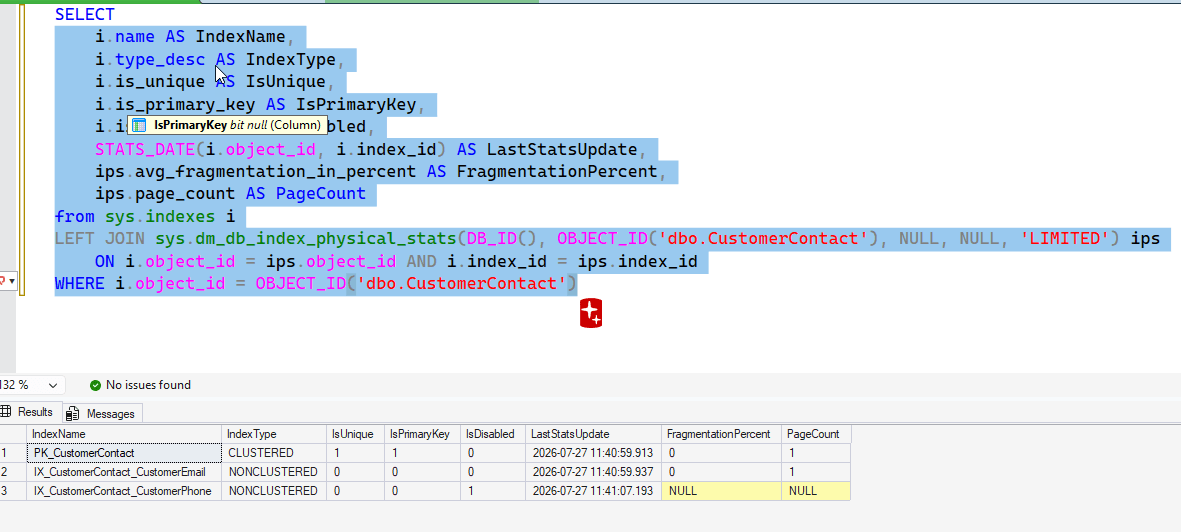 I decide to rebuild all indexes with this command:
ALTER INDEX ALL ON dbo.CustomerContact rebuildAfter I do this, what will I see for the index status? See possible answers