
Audit script for User/Group permissions on a datab
SQL SCRIPT TO AUDIT THE PERMISSIONS FOR OBJECTS IN A DATABASE.
2004-12-21 (first published: 2004-12-06)
442 reads
SQL SCRIPT TO AUDIT THE PERMISSIONS FOR OBJECTS IN A DATABASE.
2004-12-21 (first published: 2004-12-06)
442 reads
Here is another variation of processing multiple records with a single procedure call but allowing for set processing.The helper functions make use of the sequencetable pattern. These helper functions can be used to parse strings into records, so one gets a list, or simply return the nth field.There are two functions that will parse into […]
2004-12-17 (first published: 2004-11-05)
798 reads
This script creates a stored proc that was intended to run from a trigger on the master..sysdatabases for each database creation. Alas. It will create three jobs for each database you apply it to. First, it'll create a job to run a full backup each Sun, at 5am (see below). Those backups will be retained […]
2004-12-16 (first published: 2004-11-11)
386 reads
Add this procedure to the master database, it can then be executed from any DB to fix orphaned users (very useful when moving back to development). Using sp_msforeachdb with the proc allows you to resolve orphaned users in all databases in a single command: SP_MSFOREACHDB "USE ?; EXEC SP_AUTOFIX_USERS;"
2004-12-15 (first published: 2004-11-12)
2,912 reads
This script creates a table named DATELOOKUP which is used for looking up date related values. Each record represents date related info about the date in the column dtDate. For example the iMonth column stores the integer value of the month of dtDate and sShortMonth stores the abbreviated name of that same month. Use this […]
2004-12-13 (first published: 2004-11-17)
227 reads
This SP takes a string to be searched as input parameter, loops through all tables, views, Sp-s in the database andreturns the name of the object it was found and number of occurences
2004-12-10 (first published: 2004-08-18)
680 reads
Simple script (alterable as needed) to verify existence of a file and execute a job if the return result = 1 (true)
2004-12-08 (first published: 2004-10-29)
141 reads
Updated Where_Am_I script to add database. This way you can park it in your master db and call it anytime you need it for another project/db.
2004-12-07 (first published: 2004-10-29)
169 reads
Is quite a joke, but useful, I guess, and, of course, improvable. It need to use two random number generator (inclued) published some weeks ago here.Some fieldtype needs to be generating-improved (e.g. images) ... I wait suggestions and improvements
2004-12-06 (first published: 2004-10-28)
346 reads
This script will update statistics on all user databases. The script can be created as a job from SQL Server Agent.
2004-12-03 (first published: 2004-10-27)
663 reads
If you spend your days tuning queries, managing pipelines, or keeping a production database...
I’ve been rebuilding my three-site SQL Server demo lab, and I ran into something...
By SQLPals
SQL Server gMSA: Why DBAs Still Aren't Using It in 2026 ...
Putting this here as we're currently on SQL Server 2019 installed on Windows Server...
Comments posted to this topic are about the item Never is Not the Policy
Comments posted to this topic are about the item Automating SSAS Multidimensional Security Audits...
I have added a few indexes to one of my tables in SQL Server 2025:
ALTER TABLE dbo.CustomerContact
ADD CONSTRAINT PK_CustomerContact
    PRIMARY KEY (CustomerID);

-- Create index on CustomerEmail
CREATE INDEX IX_CustomerContact_CustomerEmail
ON dbo.CustomerContact (CustomerEmail);
CREATE INDEX IX_CustomerContact_CustomerEmail
ON dbo.CustomerContact (phone);
I then do this to disable one index:
alter index IX_CustomerContact_CustomerPhone on dbo.CustomerContact disableI see this when I check the index status:
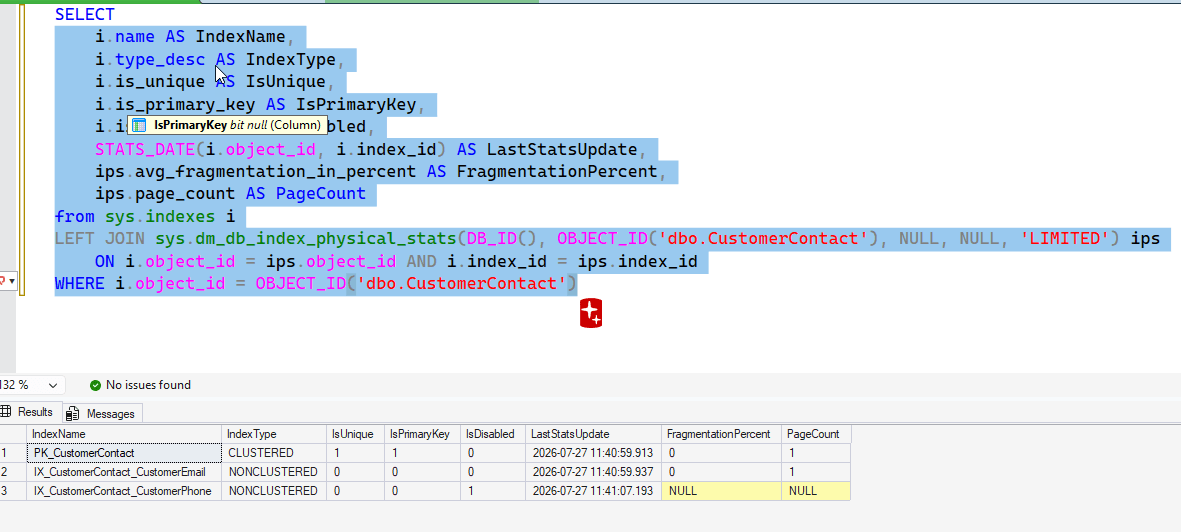 I decide to rebuild all indexes with this command:
ALTER INDEX ALL ON dbo.CustomerContactAfter I do this, what will I see for the index status? See possible answers