

This time just a short heads up, as I wanted to download the ISO for SQL Server 2025, I noticed there is also a Standard Developer Edition ISO available.
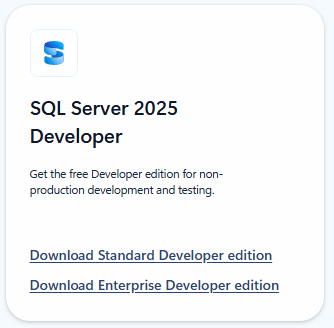
This is a new no-cost edition for development purposes.
Many of us have struggled with the fact that SQL Server Developer Edition always acted as a full-featured Enterprise Edition, only restricted by its usage in its licensing agreement. That is ancient history as of 2025-11-18 with the release of SQL Server 2025. Time to test it out!
After I mounted the downloaded Standard Developer Edition ISO, I've found the DefaultSetup.ini file in its x64 folder. For the regular SQL Server (Enterprise) Developer Edition, I know the content of that file is only its product key ( PID="22222-00000-00000-00000-00000" ).
For Standard Developer Edition that file contains:
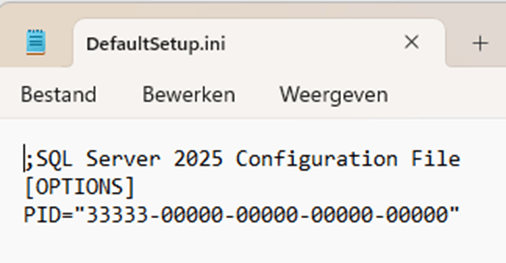
As this file (and key) is embedded in the ISO, it is available to you.
During installation, you'll accept the license agreement, restricting its usage for development purposes only. ( In my template I use the parameter IACCEPTSQLSERVERLICENSETERMS="True" )
Curious as I was, I used the Enterprise Developer Edition ISO in combination with this new product key. I used my regular template (attachted) for local sql server instance installs, and only modified this key. The installation went without a problem and after finalizing my configuration to our standards, the first test proved its worth.
Here I am trying to use an Enterprise Edition feature (online index rebuild), and it does not work: (ref: "Editions and supported features of SQL Server 2025" )
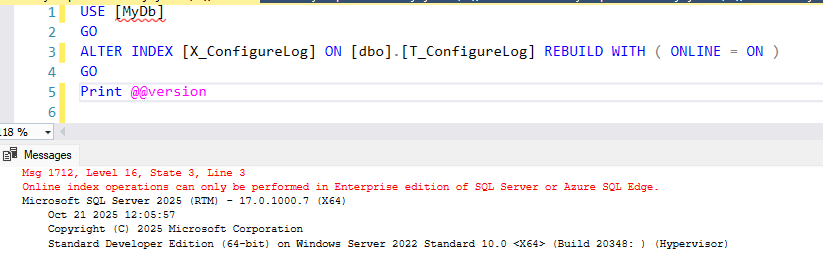
Conclusion
Now we can actually let our developers code on a SQL Server Development instance which applies the Standard Edition restrictions, from now on known by the name SQL Server 2025 Standard Developer Edition.
This Standard Developer Edition, enforces its consumers to write code to meet all standard edition "restrictions", developers can now code their application to meet these criteria without the need for a Standard Edition ( paid license! ) , for applications which are intended to be able to run on SQL Server Standard Edition environments.
( Only after I performed this test I found its announcement by Joey D'Antoni: “The Requested Feature of SQL Server 2025” )
