
Splitting strings
There are many split-functions out there. This is very fast because there is only two string manipulation functions involved, and not per-part string manipulation.
2007-08-28 (first published: 2007-02-12)
504 reads
There are many split-functions out there. This is very fast because there is only two string manipulation functions involved, and not per-part string manipulation.
2007-08-28 (first published: 2007-02-12)
504 reads
The ParseName function is very useful for getting parts out of a string of characters between delimiters. But a limitiation is that you only can get four parts out, and the function only accepts dots as delimiters.The function I have written below overcomes that limitations, and add a new feature to enable "from left" and […]
2007-08-27 (first published: 2007-02-12)
337 reads
2007-08-23 (first published: 2007-02-06)
617 reads
Delete duplicates with a CTE (common table expression).This script uses the same setup as the anonymous post using a cursor (http://www.sqlservercentral.com/scripts/viewscript.asp?scriptid=1872).
2007-08-23
1,123 reads
Here is my replacement for sp_spaceused, I have altered it so that if no table is past in using the @objname parameter it loops through all the tables which is alot easyer than running the old one for each table and it displays the data one result set. So should be easyer to create a […]
2007-08-23
1,065 reads
2007-08-22 (first published: 2007-02-06)
941 reads
I wrote this script to compare record counts between a live database and a restored copy to test backups, I thought people might find it useful. What You need is to just copy the script and run it against your database.
2007-08-21
1,428 reads
Simple bugfixes of another script found on this site.- bug 1 - Puntuation (dot) in database names made the script fail.
2007-08-21 (first published: 2007-02-04)
346 reads
Scripting SQL Server DDLRichard SutherlandIf you buy into the theory that all database objects should be contained in a source management system such as Visual SourceSafe, and that deployment of database projects should be done from the source management system, then the manner in which Microsoft's Visual Studio 2005 Team Edition for Database Professionals [a.k.a., […]
2007-08-20 (first published: 2007-02-03)
1,419 reads
To report indexes proposed by the database engine that have highest probable user impact. Note that no consideration is given to 'reasonableness' of indexes-- bytes, overall size, total number of indexes on a table, etc. Intended to provide targeted starting point for holistic evaluation of indexes.
2007-08-17
998 reads
By Steve Jones
I recently started playing with the MCP Server for SQL Server, which is a...
If you spend your days tuning queries, managing pipelines, or keeping a production database...
I’ve been rebuilding my three-site SQL Server demo lab, and I ran into something...
Hub Via Wa 628218154374 Alamat Jl. A. R. Hakim No.2, Mangkukusuman, Kec. Tegal Tim.,...
Hub Via Wa 628217555651 Alamat Jl. Jend. Sudirman Jl. Diponegoro No.15, Salatiga, Kec. Sidorejo,...
Hub Via Wa:62817825533 Alamat Jl. Diponegoro No.27, Dukuh, Kec. Pekalongan Utara, Kota Pekalongan, Jawa...
I have added a few indexes to one of my tables in SQL Server 2025:
ALTER TABLE dbo.CustomerContact
ADD CONSTRAINT PK_CustomerContact
    PRIMARY KEY (CustomerID);

-- Create index on CustomerEmail
CREATE INDEX IX_CustomerContact_CustomerEmail
ON dbo.CustomerContact (CustomerEmail);
CREATE INDEX IX_CustomerContact_CustomerPhone
ON dbo.CustomerContact (phone);
I then do this to disable one index:
alter index IX_CustomerContact_CustomerPhone on dbo.CustomerContact disableI see this when I check the index status:
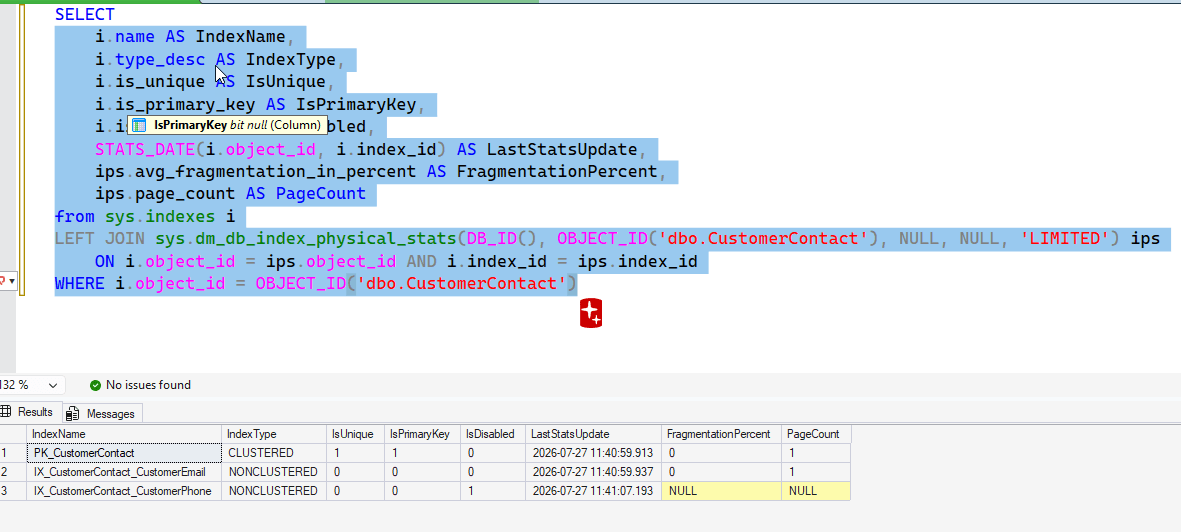 I decide to rebuild all indexes with this command:
ALTER INDEX ALL ON dbo.CustomerContact rebuildAfter I do this, what will I see for the index status? See possible answers