
Function to find non-printable characters
The function is used to find non-printable ASCII characters in an input string.
2009-05-21 (first published: 2009-04-24)
2,956 reads
The function is used to find non-printable ASCII characters in an input string.
2009-05-21 (first published: 2009-04-24)
2,956 reads
Lists the Databases and their Backups status in a neatly formatted HTML Email
2009-05-19 (first published: 2009-04-23)
2,982 reads
2009-05-14 (first published: 2009-04-08)
1,994 reads
Needed to return the week ending date as Sunday for daily transactions multiple times, for several aggregate reports. This function returns the last Sunday for past or future weeks.
2009-05-11 (first published: 2009-04-15)
661 reads
This script will display information about the instance(s) on your cluster. Name of nodes, active node and drive letters of the resources
2009-05-08 (first published: 2009-04-15)
1,417 reads
2009-05-07 (first published: 2009-03-27)
1,612 reads
International Applications require timezone handling for different users Here is how to do this with SQL.
2009-05-06
4,164 reads
This quick and dirty sql will tell you the number of rows in your tables, the size in MB of yout data, and the total size (including indexes)
2009-05-04 (first published: 2008-10-04)
1,680 reads
This script returns the information of all SQL Jobs that are running on the server with the latest status.
2009-05-01 (first published: 2009-04-08)
1,634 reads
Checks if a sql server job ran successfully in the last xx minutes.
2009-04-29 (first published: 2009-04-02)
1,449 reads
By Steve Jones
I recently started playing with the MCP Server for SQL Server, which is a...
If you spend your days tuning queries, managing pipelines, or keeping a production database...
I’ve been rebuilding my three-site SQL Server demo lab, and I ran into something...
Hub Via Wa 628218154374 Alamat Jl. A. R. Hakim No.2, Mangkukusuman, Kec. Tegal Tim.,...
Hub Via Wa 628217555651 Alamat Jl. Jend. Sudirman Jl. Diponegoro No.15, Salatiga, Kec. Sidorejo,...
Hub Via Wa:62817825533 Alamat Jl. Diponegoro No.27, Dukuh, Kec. Pekalongan Utara, Kota Pekalongan, Jawa...
I have added a few indexes to one of my tables in SQL Server 2025:
ALTER TABLE dbo.CustomerContact
ADD CONSTRAINT PK_CustomerContact
    PRIMARY KEY (CustomerID);

-- Create index on CustomerEmail
CREATE INDEX IX_CustomerContact_CustomerEmail
ON dbo.CustomerContact (CustomerEmail);
CREATE INDEX IX_CustomerContact_CustomerPhone
ON dbo.CustomerContact (phone);
I then do this to disable one index:
alter index IX_CustomerContact_CustomerPhone on dbo.CustomerContact disableI see this when I check the index status:
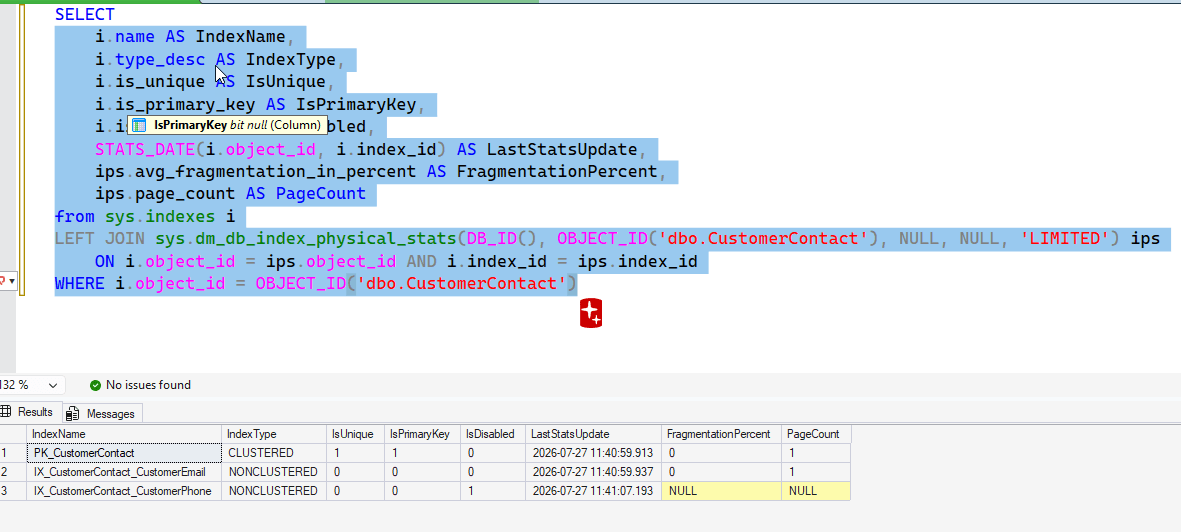 I decide to rebuild all indexes with this command:
ALTER INDEX ALL ON dbo.CustomerContact rebuildAfter I do this, what will I see for the index status? See possible answers