
Discover and Clean Up Schema Ownership
My colleagues and I take schema ownership seriously. The owner (with few exceptions) should always be “dbo”. Certainly, it should not be a user. Why? Because if the user...
2020-02-03
57 reads
My colleagues and I take schema ownership seriously. The owner (with few exceptions) should always be “dbo”. Certainly, it should not be a user. Why? Because if the user...
2020-02-03
57 reads

As always all updates can be found on our Github repo Breaking changes (Powershell collection): We only test the powershell collection against 2-3 servers so please test carefully before...
2020-02-03
37 reads
This is the first of several posts on modernizing T-SQL code with new features and functionality available in SQL Server.
Last year, you finally retired the last of your SQL...
2020-02-03
13 reads
This is the first of several posts on modernizing T-SQL code with new features and functionality available in SQL Server. Last year, you finally retired the last of your...
2020-02-03
13 reads

Below is the January list of changes and updates to the Undercover Tools. Undercover Catalogue Update 0.4.0Major upgrade, see https://sqlundercover.com/2020/01/06/undercover-catalogue-0-4-0-released/ for full details Update 0.4.1ServerConfig module added, detailing settings...
2020-02-03
24 reads
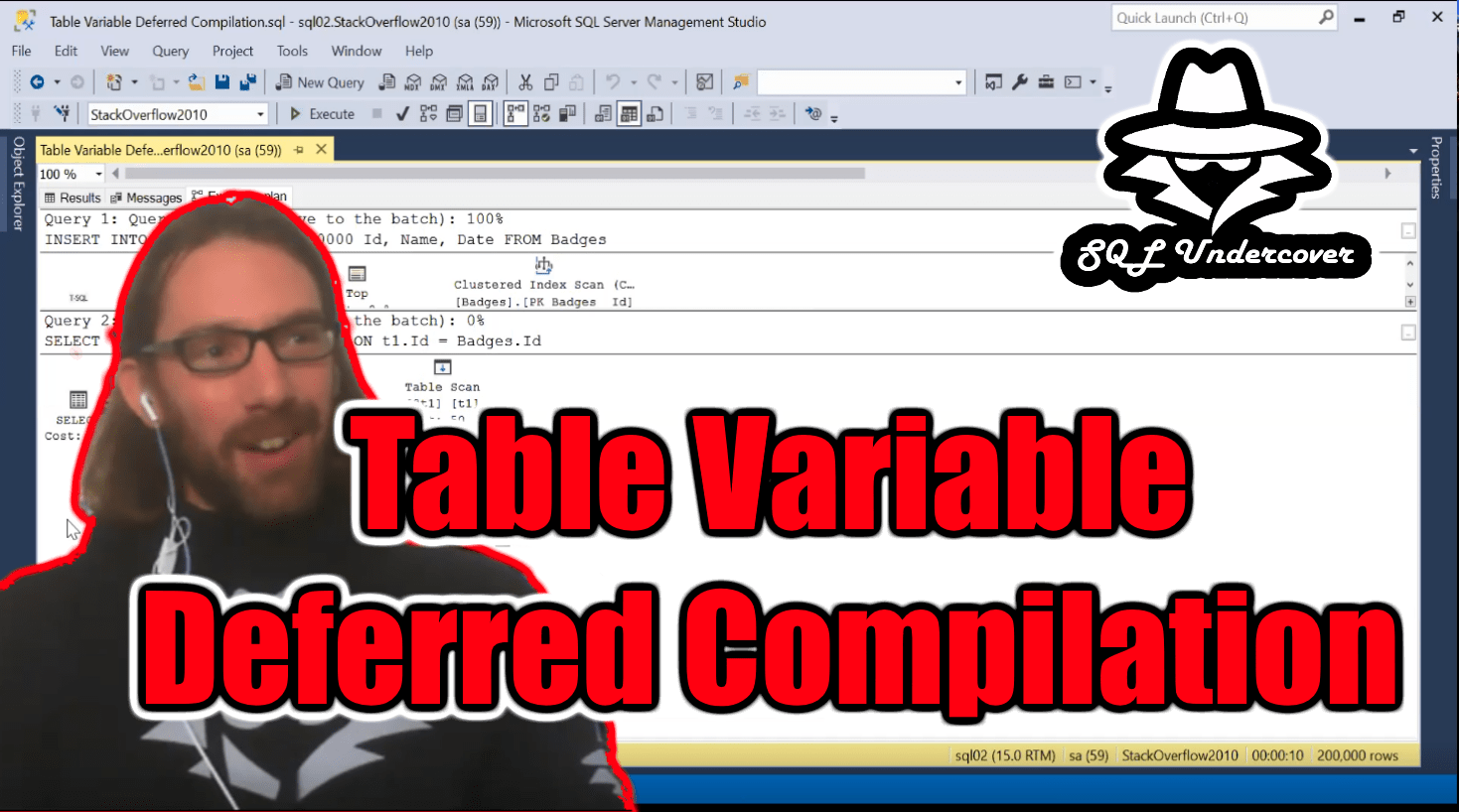
David takes a look at a new feature of SQL 2019, table variable deferred compilation
2020-02-03
22 reads
Hello. We have a beautiful date today, haven’t we? And LWR posts are coming back after a long one-month break. Press Columnstore Indexes – part 130 (“Columnstore Indexes on...
2020-02-02
9 reads
Hello. We have a beautiful date today, haven’t we? And LWR posts are coming back after a long one-month break. Press Columnstore Indexes – part 130 (“Columnstore Indexes on...
2020-02-02
5 reads
2020-02-02
9 reads
Thank you to everyone who came out to see my presentation Keys to a Healthy Relationship with SQL Server at SQL Saturday Cleveland. I had a great time and...
2020-02-02
13 reads
By Steve Jones
It’s Prime Day. A few of my recommendations, since I want to do some...
With Fabric Mirroring, Microsoft is promoting a nice and appealing story for operational reporting...
If you’ve been watching AI roll through the data community and thinking, “this seems...
Comments posted to this topic are about the item SQL Art, Part 4: Happy...
Hi All I am trying to find 'bad' characters that users might type in....
Comments posted to this topic are about the item Extreme DAX: Take your Power...
I set up a few users on my SQL Server 2022 instance.
CREATE LOGIN User1 WITH PASSWORD = 'Demo12#1'
CREATE USER User1 FOR LOGIN User1
GO
CREATE LOGIN User2 WITH PASSWORD = 'Demo12#2'
CREATE USER User2 FOR LOGIN User2
GO
CREATE LOGIN User3 WITH PASSWORD = 'Demo12#3'
CREATE USER User3 FOR LOGIN User3
GO
I then created a schema that one of them owned. Under this schema, I added a table with some data.
CREATE SCHEMA MySchema AUTHORIZATION User1
GO
CREATE TABLE Myschema.MyTable(myid INT)
GO
INSERT MySchema.MyTable
(
    myid
)
VALUES
(1), (2), (3)
GO
SELECT * FROM MySchema.MyTable
GO
I granted rights and verified that User2 could access this table.
GRANT SELECT ON Myschema.MyTable TO User2
GO
SETUSER 'USER2'
GO
SELECT * FROM MySchema.MyTable
GO
This worked. Now, I move this schema to a new user.
ALTER AUTHORIZATION ON SCHEMA::Myschema TO User3;
GO
What happens with this code?
SETUSER 'USER2'
GO
SELECT * FROM MySchema.MyTable
GO
See possible answers