Scripts

Technical Article

Update statistics in all database (sp_updatestats)

This script permit executes the sp_updatestats in all databases at same time.First I create the stored procedure above in an admin database, for sample I create one database with ADMIN name where I put all administration objects create for me. You can create this sp in exist db, if you want.Now you can execute this […]

(2)

You rated this post out of 5. Change rating

2005-04-14 (first published: )

4,174 reads

Technical Article

Find maximum values for all "int" columns

/******************************************************** "CheckAllInts" Find all columns in all user tables in a database defined as "int", and get the maximum value for the column. Uses a cursor and logs the results to a table. (One-time CREATE TABLE statement at top of script). Successive runs over an appropriate period of time would allow one to find how […]

You rated this post out of 5. Change rating

2005-04-11 (first published: )

348 reads

Technical Article

getCalendarQTR

The script returns the quarter and year of a date submitted in the form of '105' - first quarter of 2005 - and is useful for grouping data by calendar quarter. Easy to modify for fiscal quarters.

You rated this post out of 5. Change rating

2005-04-07 (first published: )

102 reads

Technical Article

SQLCalcEngine - evaluate numeric expression

SQLCalcEngine - evaluate numeric expression similar to the VB eval function.The basic concept is to pass a string containing a numeric expression such as ((2+3)*(4/9)) and receive a numeric value back. The algorithm is based loosely on material found at http://www.arstdesign.com/articles/expression_evaluation.html, as well as material found in the book "Writing Compilers and Interpreters" by Ronald […]

You rated this post out of 5. Change rating

2005-03-31 (first published: )

333 reads

Technical Article

Get all user information at the database level

This is based on Clint Herring's work and was better than what I was using ;). It has one user definded variable @path that is where to store the files generated. It will make one file per database and one master file to restore all user permissions into that database. Used mostly for DR and […]

You rated this post out of 5. Change rating

2005-03-30 (first published: )

1,036 reads

Blogs

Accessing the Data API Builder MCP Server from VS Code

By

I recently started playing with the MCP Server for SQL Server, which is a...

From DBA or Data Engineer to AI Engineer: A Realistic Path

By

If you spend your days tuning queries, managing pipelines, or keeping a production database...

Asynchronous Replication of Snapshots from an ActiveCluster Pod to a Third Array

By

I’ve been rebuilding my three-site SQL Server demo lab, and I ran into something...

Read the latest Blogs

Forums

STRING_AGG DISTINCT

By Phil Parkin

Has anyone written a wrapper function (or similar) around STRING_AGG() to allow the retrieval...

In-place OS upgrade or migration to new OS?

By jasona.work

Putting this here as we're currently on SQL Server 2019 installed on Windows Server...

Never is Not the Policy

By Steve Jones - SSC Editor

Comments posted to this topic are about the item Never is Not the Policy

Visit the forum

Question of the Day

Rebuilding All Indexes

I have added a few indexes to one of my tables in SQL Server 2025:

ALTER TABLE dbo.CustomerContact
ADD CONSTRAINT PK_CustomerContact
    PRIMARY KEY (CustomerID);

-- Create index on CustomerEmail
CREATE INDEX IX_CustomerContact_CustomerEmail
ON dbo.CustomerContact (CustomerEmail);
CREATE INDEX IX_CustomerContact_CustomerPhone
ON dbo.CustomerContact (phone);
I then do this to disable one index:
alter index IX_CustomerContact_CustomerPhone on dbo.CustomerContact disable
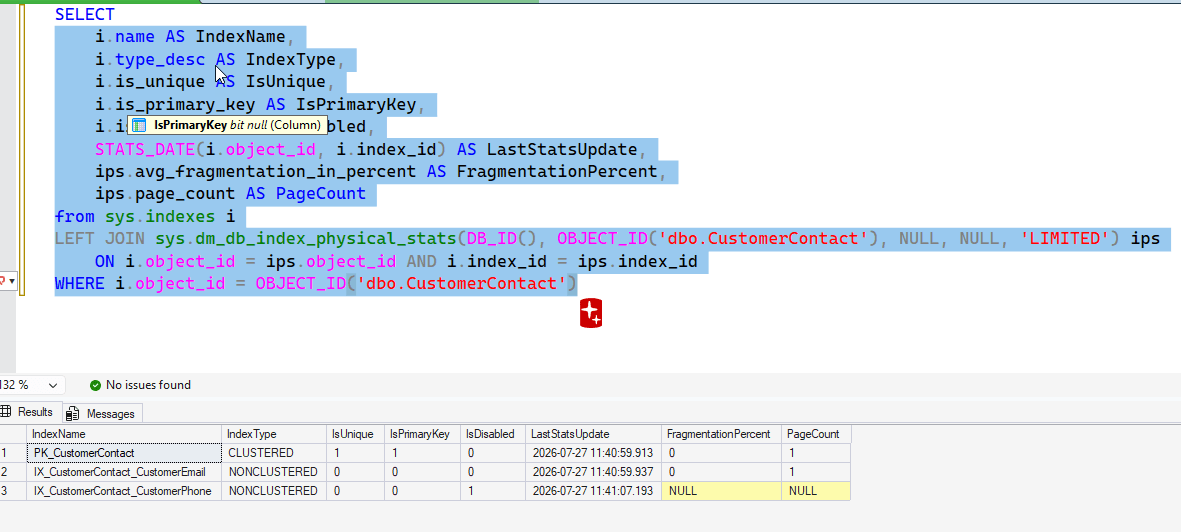
I see this when I check the index status:Index status for CustomerContactI decide to rebuild all indexes with this command:
ALTER INDEX ALL ON dbo.CustomerContact rebuild
After I do this, what will I see for the index status?

See possible answers