
Deleting old files (with/without archive bit)
A hopefully useful script to delete old files, not just backups, and make use of the archive bit.
2009-01-01 (first published: 2008-12-09)
2,507 reads
A hopefully useful script to delete old files, not just backups, and make use of the archive bit.
2009-01-01 (first published: 2008-12-09)
2,507 reads
This script helps with restoring backup files SQL Server 2005
2008-12-31 (first published: 2008-12-11)
1,610 reads
This is used to insert the multiple values using a single insert statment.
2008-12-31
525 reads
This should find all tables referenced by an sp. It uses syscomments and hence has a wrap 'issue'.
2008-12-30 (first published: 2008-12-05)
1,043 reads
we need change all user table db owners For selected database using T SQL we can easily use this method.
2008-12-29 (first published: 2008-11-30)
1,235 reads
Capturing the execution time for rebuilding an index for set of tables.
2008-12-26 (first published: 2008-11-27)
1,714 reads
This article explains a simple solution for the common problem in MSSQL 7.0/2000, finding & deleting duplicate records from a table.
2008-12-24 (first published: 2008-11-26)
2,829 reads
2008-12-23 (first published: 2008-11-10)
2,951 reads
i have recently had the need to search the every database on the server for a particular string.
i came up with this... it has lots of room for improvement but it works
2008-12-19 (first published: 2008-11-11)
1,004 reads
I couldn't find a solid script for this so I put this together. It creates the database EXACTLY as it was with growth and proper file groups.
2008-12-18 (first published: 2008-11-14)
1,279 reads
By Steve Jones
I recently started playing with the MCP Server for SQL Server, which is a...
If you spend your days tuning queries, managing pipelines, or keeping a production database...
I’ve been rebuilding my three-site SQL Server demo lab, and I ran into something...
Has anyone written a wrapper function (or similar) around STRING_AGG() to allow the retrieval...
Putting this here as we're currently on SQL Server 2019 installed on Windows Server...
Comments posted to this topic are about the item Never is Not the Policy
I have added a few indexes to one of my tables in SQL Server 2025:
ALTER TABLE dbo.CustomerContact
ADD CONSTRAINT PK_CustomerContact
    PRIMARY KEY (CustomerID);

-- Create index on CustomerEmail
CREATE INDEX IX_CustomerContact_CustomerEmail
ON dbo.CustomerContact (CustomerEmail);
CREATE INDEX IX_CustomerContact_CustomerPhone
ON dbo.CustomerContact (phone);
I then do this to disable one index:
alter index IX_CustomerContact_CustomerPhone on dbo.CustomerContact disableI see this when I check the index status:
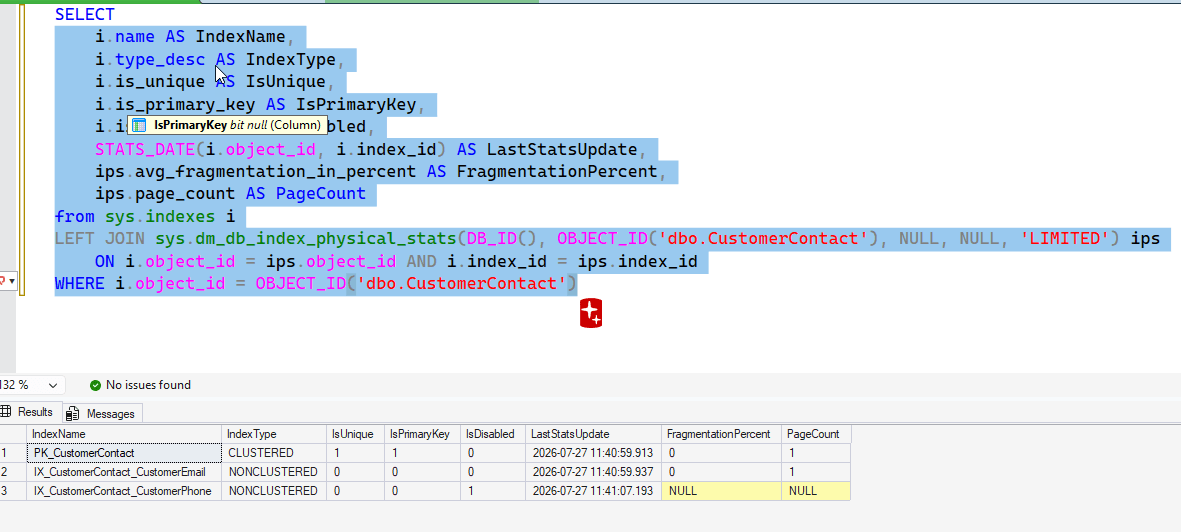 I decide to rebuild all indexes with this command:
ALTER INDEX ALL ON dbo.CustomerContact rebuildAfter I do this, what will I see for the index status? See possible answers