Logic question in a WHERE clause using IIF?
-
Thanks in advance,
I'm trying to avoid using IIF for performance reasons, but the code has me stumped.
I'm trying to add a filter in my WHERE clause that basically says "omit records if [BillingReason] in (1, 2, 3) AND ([NewInsID] IS NOT NULL AND [OldInsID] IS NOT NULL)". For example:
[BillingReason] = 1, [NewInsID] = Null, [OldInsID] =Null -- Omit this record
[BillingReason] = 4, [NewInsID] = Null, [OldInsID] =Null -- Include this record
[BillingReason] = 1, [NewInsID] = 123456, [OldInsID] = 456789 -- Include this record
[BillingReason] = 2, [NewInsID] = 123456, [OldInsID] = 456789 -- Include this record
[BillingReason] = 3, [NewInsID] = Null, [OldInsID] = Null -- Omit this record
- DaveBriCam wrote:
I'm trying to add a filter in my WHERE clause that basically says "omit records if [BillingReason] in (1, 2, 3) AND ([NewInsID] IS NOT NULL AND [OldInsID] IS NOT NULL)".
The topic says "omit records if..." but the t-sql WHERE clause, in effect, says "keep rows if..." (all predicate conditions are TRUE). The examples show you want to omit the two different conditions when: 1) BillingReason IN (1,2,3), and 2) both ID's are NULL. To implement that logic in the WHERE clause (where all conditions must evaluate to TRUE) you could apply De Morgan's Law and invert the expression
WHERE BillingReason NOT IN (1,2,3)
      OR NOT (NewInsID IS NULL AND OldInsID IS NULL)
If BillingReason is a NULL'able column then any NULL values would be omitted. If you want NULL BillingReason rows included add an explicit "OR BillingReason IS NULL" (rather than wrapping the column in ISNULL()/COALESCE(), which can prevent sargability). Maybe like this
WHERE (BillingReason NOT IN (1,2,3) OR BillingReason IS NULL)
OR NOT (NewInsID IS NULL AND OldInsID IS NULL)Aus dem Paradies, das Cantor uns geschaffen, soll uns niemand vertreiben können
-
Just wrap the whole thing in a NOT:
WHERE NOT (
    [BillingReason] IN (1, 2, 3)
    AND [NewInsID] IS NOT NULL
    AND [OldInsID] IS NOT NULL
)
Or use De Morgan's law
WHERE [BillingReason] NOT IN (1, 2, 3)
   OR [NewInsID] IS NULL
   OR [OldInsID] IS NULL
If BillingReason can itself be NULL the two forms can behave differently because of SQL's three-valued logic. The NOT (...) version is also subject to UNKNOWN in that case, so if BillingReason IS NULL should definitely be retained
WHERE [BillingReason] IS NULL
   OR NOT (
       [BillingReason] IN (1, 2, 3)
       AND [NewInsID] IS NOT NULL
       AND [OldInsID] IS NOT NULL
) -

-
another worthless image that can't be fully read. put plain text next time please.
-
WHERE

          BillingReason NOT IN (1,2,3)
          OR

COALESCE(NewInsID, OldInsID) IS NOT NULL -
WHERE

            BillingReason NOT IN (1,2,3)
              OR

EXISTS (SELECT 1 FROM Insurance i WHERE i.ID IN (NewInsID, OldInsID)) -
-- Filtered Index

CREATE NONCLUSTERED INDEX IX_BillingReason_Filtered
ON dbo.YourTable (BillingReason)
WHERE BillingReason NOT IN (1,2,3); - frederico_fonseca wrote:
another worthless image that can't be fully read. put plain text next time please.
Yeah 4 worthless answers in one topic. 3 of them are basically unrelated to the question being asked. The COALESCE version is dangerous tho. It happens to return correct results for these examples but it encodes a different rule — 'keep if either ID has a value' vs 'keep if both IDs have values.' When one ID is NULL and the other isn't it will return incorrect results
Jonathan and me have slightly different answers but both follow the same reasoning. The topic itself is inconsistent between the description and the examples. The description says to omit when both ID's are not null. The examples do the opposite. Jonathan correctly coded the t-sql based on the description. My answer coded based on the examples. The other difference is Jonathan applies De Morgan's Law twice whereby the 2 parentheses were removed from the compound condition (on ID's)
-- the original conditions (from the description) are to omit if these 2 conditions are true
 [BillingReason] in (1, 2, 3)
AND
 ([NewInsID] IS NOT NULL AND [OldInsID] IS NOT NULL)
Aus dem Paradies, das Cantor uns geschaffen, soll uns niemand vertreiben können
-
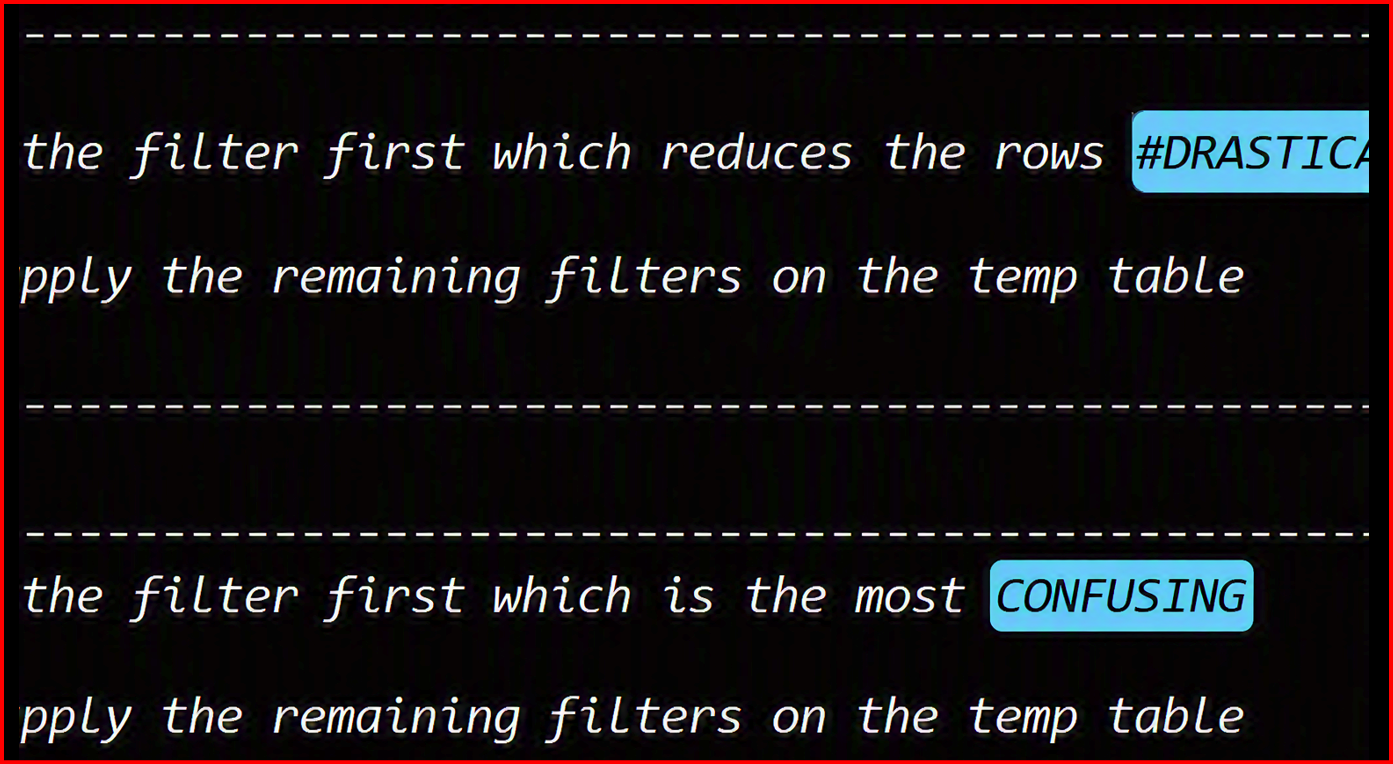
another thing is #the rowcount of each filter # design depends on that # 10 or 100,000
-
Thanks!... this worked perfectly after a slight modification - changing the IS NOT NULL to IS NULL:
WHERE NOT (
[BillingReason] IN (1, 2, 3)
AND [NewInsID] IS NULL
AND [OldInsID] IS NULL
)
Viewing 11 posts - 1 through 11 (of 11 total)
You must be logged in to reply to this topic. Login to reply