The Quiet Part
-
Comments posted to this topic are about the item The Quiet Part
-
I'm working more in data governance and compliance now and California and Colorado (among others) are enacting strong legislation around Automated Decisioning, so this was quite timely. Colorado's law doesn't even give much relief for human-in-the-loop on "significant decisions" and these HR items would definitely fall in that realm.
This is another example of why I'm worried about cognitive surrender, and why real conversations around requirements are so vital to functioning organizations.
-
Under the European GDPR, any decision based on an AI is an automated decision if there is no meaningful human decisionmaking based on the AI recommendation. And automated decisions by AI that have negative consequences for people are illegal and can lead to quite severe fines.
The AI Act is also quite strict about things like using AI for recommendations that humans then rubberstamp. The company remains responsible for the outcome but is extra liable if things go wrong.
Meta just got a 500 million fine today for something else. But if they do this in the EU they will get *another* fine, a much bigger one I think.
-
see THERE are many things people do ???
if government wants humans to do it or "in the loop"
follow exactly what they say becuase thats what they want
but HOW HOW do a bunch of humans "DUPLICATE AI" ????

-
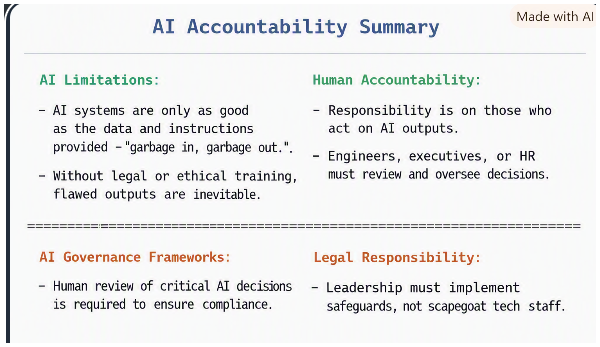
One of the problems with letting an "AI" make the sort of decisions as the article listed is, the "AI" is no better than GIGO. Sure, you could craft your prompt with the finest sort of "make sure any such list of people to fire complies with all local, state, and federal laws," but if your "AI" never had those laws in its' training material, it's going to make mistakes.
As for who should be "responsible" at Meta when the lawsuit is settled (read as: "encouraged" to resign / outright fired) that's a rather thornier problem. Is it the engineers who trained the "AI?" Is it the person who keyed in the prompt? Is it the exec who told their staff "ask the "AI" who we should let go based on X, Y, and Z?" Or is it the HR staffer(s) who blindly accepted a list of names from the "AI" and sent out the "pack up your desk and turn in your badge" notices? One could, depending on who you're talking to, argue fairly persuasively for anyone on that list to be the scapegoat and with the audience here being largely techies, we'd see the obvious scapegoating if either of the first two were fired unless evidence was shown that they intentionally acted in such a way to cause the problem (explicitly excluding the laws about medical leave for the engineers, writing the prompt to ignore laws)
Realistically, I would bet if Meta either had a team of people go through the employee info using the same criteria as the "AI" to generate the list of "let these people go," they would've been smart enough to also notice "Oh, Janice is on maternity leave, pretty sure there's something that says firing her for this would be a problem," or "Joe is on medical / FMLA leave, letting him go might be a problem," or just going to a company lawyer and ASKING if there's reasons that Janice or Joe couldn't be let go.
But, I'd bet that what happened was, prompt went in (GI), names came out (GO), and HR staff never HAD enough info to realize some of the people on the list would have a really, really good lawsuit if they were let go, and just fed the names into an email generator and went out for drinks.
Right now, the only solution that comes to mind with using any "AI" is one both Steve and Grant have said. Treat it like a really enthusiastic, but not too bright, intern, who is going to do only and exactly what you ask and nothing more or less. Because in the end, a living, breathing human is going to have to be responsible for what that "AI" did, whether generating a list of people to fire that breaks the law or pushing a change to a production database as sysadmin that includes "DROP DATABASE MASTER" somewhere in it...
-
made using AI
-
thats SORT OF "sorta"
one way of seeing things ( sh..t loads of different types of thinkings are there )
- dwhitley wrote:
I'm working more in data governance and compliance now and California and Colorado (among others) are enacting strong legislation around Automated Decisioning, so this was quite timely. Colorado's law doesn't even give much relief for human-in-the-loop on "significant decisions" and these HR items would definitely fall in that realm. This is another example of why I'm worried about cognitive surrender, and why real conversations around requirements are so vital to functioning organizations.
People have always given in to someone or something else making decisions, so cognitive surrender (if I understand it) is a constant problem. If you don't let it impact you, it won't.
- ronaldkunenborg wrote:
Under the European GDPR, any decision based on an AI is an automated decision if there is no meaningful human decisionmaking based on the AI recommendation. And automated decisions by AI that have negative consequences for people are illegal and can lead to quite severe fines. The AI Act is also quite strict about things like using AI for recommendations that humans then rubberstamp. The company remains responsible for the outcome but is extra liable if things go wrong. Meta just got a 500 million fine today for something else. But if they do this in the EU they will get *another* fine, a much bigger one I think.
That's a good approach. I wish the US were more like that
-
Orgs always want to move blame around. It's one of the reasons accountability is hard. Is it the data scientist or engineer that built the system and encourage users to trust it? Is it the HR person who shouldnt be trusting the system as much?
To me, it's the HR person first and foremost. They have to have the judgment to know what the law is and double check that the names that came out (if GO) had legitimate reasons.
It's also likely someone(s) in HR that accepted a decision that not working as manyhours is a reason for termination without adding more context or info to it.



Viewing 10 posts - 1 through 10 (of 10 total)
You must be logged in to reply to this topic. Login to reply