Problems displaying this newsletter? View online.
Database Weekly
The Complete Weekly Roundup of SQL Server News by SQLServerCentral.com
Hand-picked content to sharpen your professional edge
Editorial
 

Four Rules for Adding AI Without Breaking What Already Works

One of my big challenges right now and due to the AI push, is that AI is part of all applications, not just new products.  I believe AI belongs in an existing application only when it solves a problem nothing simpler can, and when everything that already works keeps working. I’ve been presenting on this at events, including a recent keynote at AI Tech World in San Francisco.

I experience this in my development work as much as a user and hear the same from many of my peers.  It doesn’t matter if we mention how Slack added an AI assistant that overlaps with their search option or when Microsoft Outlook hid the attach button to promote AI features on the ribbon. Those of us who use Mural to design projects discovered the vendor had put an "Ask AI" button on top of the "Start Here." It's as if the industry forgot how to do any application testing.

The Pressure is Real

AI features are the most requested additions in software right now, and the request rarely comes with a clear reason. Product managers want it on the roadmap, executives see competitors shipping it, and investors expect to hear about it, soooo, teams rub a little AI on it.

The results are as we would expect with AI bolted onto flows that weren't built for it, slower responses, new authentication cases, users who can't tell what the AI decided, and existing features impacted. Mobile makes all of it worse with its limited real estate and the demand for space for natural language AI.  Features people relied on get slower or break, often where a rules-based workflow would have done the job.

In my presentation, I sometimes feel like I’m lecturing a bit, but I recommend we all follow four rules to avoid this.

Rule 1: Solve a real problem, not a checkbox

Start with the user's problem, not AI technology. "How can we add AI?" usually leads to a weak use case. "What problem does AI solve that nothing else can?" leads to a real one.  Rarely does anything good come from having a solution before you have a problem you’re trying to fix.

If a filter, a lookup or a better form gets the user there faster, use it. When marketing pushes, ask whether the claim needs to survive a press release or a support ticket. When someone asks for "something like ChatGPT," find out what they mean. Usually it's the interface they want, not the model.

Rule 2: New AI must never break what already works

This is the rule that I’ve seen broken the most and it’s happening in a lot of enterprise applications, which is sobering. If people find a commonly used feature missing or unusable because of a new AI feature, you’ve failed to implement AI in my opinion.

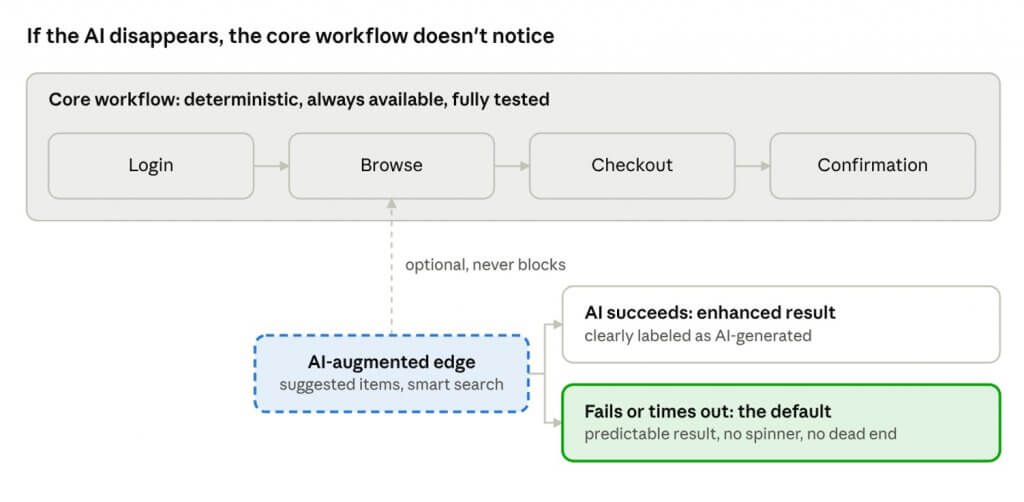
We also should not reinvent the wheel with a hyped up hoverboard and make it the user’s problem to learn or pay for it.  Keep AI out of the critical path features that already work: Login, checkout and data integrity should never depend on a model. AI can sit beside a step, like suggested items or smarter search, but it should never block one.

Every AI call also needs a planned answer for when it fails, times out or returns nonsense. Design that fallback before you build the AI path and make sure it doesn’t just rely on the AI, resulting in a failure.

figure 1: AI at the edge of a core workflow, with its fallback

The core path should never wait on the model; whichever way the AI call goes, the user lands somewhere useful, even if it’s not as cool as your AI solution.

Testing has to change too. The same input can return different valid answers, your uptime now depends on someone else's. This  may change the uptime SLAs that you once had locked down once AI comes into the landscape, so keep that in mind.  For data security, you also need to know what data leaves your system and how long it's kept.  You owe that to your customer/user and you will be asked questions around that topic.

Rule 3: Prove the return, not just the build cost

AI features cost money every time they're developed, as well as used, and that cost often lands on the customer. Before building, work out what the feature costs to build and to run, and whether a higher price will hurt sales. If it looks promising, include a ROI calculator so customers can see the value and decide for themselves.

You also need to measure outcomes, not AI activity. Prompt counts and the share of sessions that touch the AI don't tell you much outside of checking a box. Task completion time, error rates, support tickets, retention and revenue provide information on real value.

Rule 4: Don't just replace features, build the gamechanger

Swapping a working feature for an AI version of the same thing adds risk and cost without giving users anything new. Please aim higher: work that rules can't handle, such as judgment-heavy automation, decision support in messy situations, personalization at scale, or tasks that need language and reasoning. If required, then keep a person in the loop and a summary button on a three-line email isn’t the same thing.

Treat AI like any other engineering decision

I'm not against AI in products, but I  do want it to be held to the same standard as any other architectural change.

Most of the fix will come from operations and review, but I believe we need to start with development.  We also need to consider new roles like AI architecture reviewers, cost and efficiency specialists, security specialists and more in the area of MLOps. And remember when we said we didn't need testers and DBAs anymore? As is my answer with most things in tech: ”Wait for it…”


Peace Out.

~DBAKevlar


The Weekly News
All the headlines and interesting SQL Server information that we've collected over the past week, and sometimes even a few repeats if we think they fit.
AI in the Database

Microsoft Defender Finds Local AI Agents as Purview Blocks Shadow AI Data Leaks

From Past News - RSS Feeds

Microsoft is extending enterprise AI security with...

AI/Machine Learning

Announcing AWS Well-Architected Agent, an AI-powered intelligence to optimize your cloud environment (preview)

From AWS News Blog

Introducing the public preview of AWS Well-Architected Agent, an AI-powered service that analyzes your AWS environment to deliver targeted, contextual recommendations for improving your applications' cost, security, performance, and...

Administration of SQL Server

SQL Server Developer Edition: Free Download Links From SQL Server 2017 to SQL Server 2025

From Journey to SQL Authority with Pinal Dave

SQL Server Developer Edition is free for development and testing, not for production. Here are the official download links for every supported version, SQL Server 2017 to SQL Server...

Page Splits and Fill Factor

From Curated SQL

Brent Ozar differentiates page splits: You’re lo...

#5 Adding users, licenses and guest access

From Paul Turley's SQL Server BI Blog

Series: Getting Started & Tenant Foundations B...

Cloud - Azure

Using the Azure Resiliency Agent

From Curated SQL

Reitse Eskens gives a copilot a spin: And that isn...

Managing Resources via Azure Cloud Shell

From Curated SQL

Jordan Boich isn’t afraid of the command line: A...

A Quick Primer on Microsoft Entra ID

From Curated SQL

Jordan Boich gives us a high-level overview: As a DBA with on-prem and cloud experience, I feel confident in saying that I’m fairly well versed…

MDX/DAX

Building Daily Averages in DAX

From Curated SQL

Marco Russo and Alberto Ferrari take generative AI...

Microsoft Fabric ( Azure Synapse Analytics, OneLake, ADLS, Data Science)

Fabric Tenant Settings to Check at Launch

From Curated SQL

Paul Turley continues a series on Microsoft Fabric: Article 3 covered the headline settings almost every tenant touches first, but the full tenant settings screen…

A First Look at Microsoft Fabric On-Demand Capacity

From Curated SQL

Reitse Eskens gives it a try: You can compare it to Serverless SQL databases: when it’s not in use, it won’t cost anything. Storage will…

Prep data for AI vs. Fabric Data Agent Instructions: What Goes Where?

From SQLServerCentral Blogs

Making Data AI-Ready, Part 3 (This is the final article in a three-part series on making data AI-ready. Part 1 covered what AI-ready data means, Part 2 looked at... The...

Fetching Query Plans in Fabric Data Warehouse

From Curated SQL

Louis Davidson shows a process: So in this next en...

Clustering in Fabric Data Warehouse

From Curated SQL

Louis Davidson does some exploring: Clustering is ...

Microsoft Fabric Apps: Business vs Data Apps – What’s the Difference?

From BI Insight

Have you ever thought about using Microsoft Fabric...

Users, Licenses, and Guest Access in Microsoft Fabric

From Curated SQL

Paul Turley manages a tenant: Fabric doesn’t have its own separate licensing screen — you assign every license, Fabric included, from the Microsoft 365 admin…

Comparing Bronze Ingestion Options in Microsoft Fabric

From Andy Broadsword

Last week we looked at the medallion architecture so I wanted to follow up by diving a little deeper into the Bronze layer by taking a practical example to compare options...

 
Oracle/MySQL/other RDBMS

Storage Engines in MySQL versus MariaDB

From Curated SQL

Lukas Vileikis compares storage engines: The big d...

Performance Tuning SQL Server

SQL Server Performance Office Hours Episode 84 – Adios Azores

From Erik Darling Data

SQL Server Performance Office Hours Episode 84 –...

The Longer Query: A Sunday SQL Illusion

From Journey to SQL Authority with Pinal Dave

The longer query seems obvious in this Sunday illu...

PostgreSQL

Ming Ying: PlanetScale Released Text Search and We Have a Lot to Say (Part I)

From Planet Postgres

Two BM25 optimizations and benchmark configuration...

Christophe Pettus: All Your GUCs in a Row: md5_password_warnings

From Planet Postgres

PostgreSQL 18 added md5_password_warnings to suppr...

David Wheeler: pg_clickhouse & chdb updates: Encoding, nesting, and types

From Planet Postgres

Out now on GitHub and PGXN, pg_clickhouse v0.11.0 ...

Amazon Aurora PostgreSQL now supports direct querying of Apache Iceberg and Parquet data in your data lake

From AWS News Blog

Amazon Aurora PostgreSQL now lets you directly que...

Chris van Eijk: Row-level security performance in PostgreSQL, measured

From Planet Postgres

What an RLS policy costs in PostgreSQL 17: functio...

Query Plan Hints in Postgres 19

From Curated SQL

Elizabeth Garrett Christensen says you may not need it: For years the Postgres community was against adding support for hints. They felt if you had…

Jimmy Angelakos: PostgresEDI September 2026 Meetup Recap: tiering to Iceberg, and Postgres from Nuxt

From Planet Postgres

Last week we had our September PostgresEDI meetup,...

Robert Haas: Hacking Workshop for October 2026

From Planet Postgres

October's hacking workshop will cover my talk, pg...

Andrew Atkinson: Let’s Get Down to Business with Rails and PostgreSQL

From Planet Postgres

I’m happy to share that I was a guest on the Rai...

Christophe Pettus: All Your GUCs in a Row: max_standby_archive_delay and max_standby_streaming_delay

From Planet Postgres

`max_standby_streaming_delay` buys you replication...

Running Postgres in Docker

From Curated SQL

Grant Fritchey spins up a container: The goal of t...

Checking archive_mode on pgBackRest

From Curated SQL

Stefan Fercot shares some advice: A recent questio...

Dmitry Narizhnykh: How to Inspect a pg_dump Without Restoring It

From Planet Postgres

You can't read a pg_dump file the way you read a t...

Christophe Pettus: All Your GUCs in a Row: max_slot_wal_keep_size

From Planet Postgres

Replication slots can silently fill your disk and ...

Querying Parquet files in R with duckdb

From DataScience+

Card payments in a New York yellow cab end on a sc...

Mikhail Shytsko: Our Interleaved Backfill Wrote Three Times the WAL

From Planet Postgres

TypeSafe opened early access to its Jev model on 1...

Christophe Pettus: All Your GUCs in a Row: max_sync_workers_per_subscription

From Planet Postgres

max_sync_workers_per_subscription parallelizes table copies across tables, not within them.

Devrim GÜNDÜZ: Using the PGDG RPM repositories are now way easier!

From Planet Postgres

yum.postgresql.org and zypp.postgresql.org have a new look! Users no longer have to navigate through pages on the website. Instead, the front page has a clear layout and easy-to-follow instructions. Just...

Christophe Pettus: All Your GUCs in a Row: max_wal_senders

From Planet Postgres

Errata: the max_connections post told you to size that parameter for “the replication connections.” On 12 and later, don’t. WAL senders have their own seats, sized by this parameter,...

Dinesh Kumar: ALTER FUNCTION SET work_mem: Fixing PostgreSQL Disk Spills Without a Global Change

From Planet Postgres

Use PostgreSQL ALTER FUNCTION SET work_mem to stop one function's sorts spilling to disk without a global change. A production fix: 150 GB a day to 0.

Power BI/PowerPivot/PowerQuery

Power Query Improvements in Power BI Report Builder

From Curated SQL

Chris Webb notes some improvements: There are some nice improvements to Power Query integration in the latest version of Power BI Report Builder that, while…

SQL Server Security and Auditing

Operational Blind Spots in SQL Server Security

From Curated SQL

Fabiano Amorim offers some advice: The SQL Server attack pattern is consistent: attackers do not always need a spectacular vulnerability. They often succeed by chaining…

T-SQL and Query Languages

Optimizing Window Functions in Derived Datasets

From DualCoreDBA

In this post, we’ll look at some interesting behaviour I’ve stumbled across with window functions and derived datasets in SQL Server. I came across a query in a workload...

 
RSS FeedTwitter
This email has been sent to {email}. To be removed from this list, please click here. If you have any problems leaving the list, please contact the webmaster@sqlservercentral.com. This newsletter was sent to you because you signed up at SQLServerCentral.com. Note: This is not the SQLServerCentral.com daily newsletter list, and unsubscribing to this newsletter will not stop you receiving the SQL Server Central daily newsletters. If you want to be removed from that list, you can follow the instructions on the daily newsletter.
©2019 Redgate Software Ltd, Newnham House, Cambridge Business Park, Cambridge, CB4 0WZ, United Kingdom. All rights reserved.
webmaster@sqlservercentral.com


- - - - - - - - - - - - - - - - - - - - - - - - - - - - - - - - -